

By Dr. Cara-Julie Kather, Researcher, Writer, and Consultant in Sexual Violence Prevention
Why Adapt Prevention?
Neurodivergent people are disproportionately affected by sexual and gender-based violence (SGBV). A study conducted by Université du Québec à Montréal (UQAM)4 found that neurodivergent youth are 11 times more likely to experience sexual violence than their neurotypical peers. Similarly, a 2022 study2 conducted in France found that 9 out of 10 autistic girls and women reported experiencing SGBV at least once in their lives, with the first experience happening underage in most cases.
Neurodivergence brings a particular kind of vulnerability towards SGBV that is enhanced further by other factors such as gender, sociodemographic background, and other forms of discrimination. Neurodivergence as a factor of vulnerability bears two core dimensions.
First, neurodivergent people often experience and interpret social norms and social cues differently, which can make it more difficult to recognize implicit messages, sexualized behaviours, or potentially risky situations.
Second, neurodivergent youth may develop a tendency to doubt their own intuition and perceptions. Growing up in a world that perceives, evaluates, and functions differently from the way they do can make it especially challenging to develop self-confidence. Yet this confidence is essential for recognizing one’s own desires and boundaries, expressing free and informed consent, and building healthy relationships.
What is Neurodivergence?
Neurodivergence is an umbrella term used to describe neurological functioning that differs from what is generally considered neurotypical7. It includes, but is not limited to, autism, Attention-Deficit/Hyperactivity Disorder (ADHD), and Post-Traumatic Stress Disorder (PTSD).
Neurodivergence has both neurological and social dimensions. While every person’s brain functions uniquely, social norms and scientific frameworks establish a reference point against which certain patterns of neurological functioning are considered more typical than others. As a result, neurodivergent people may sense, understand, and process the world differently from one another and this shapes educational experiences, social interactions, and sexuality.
Realities to Consider
Because neurodivergence is such a big umbrella term, there are no universal examples of the lived experiences of neurodivergent youth. The following testimonials illustrate some of the realities that can shape the development of relationships, intimacy, and sexuality1.
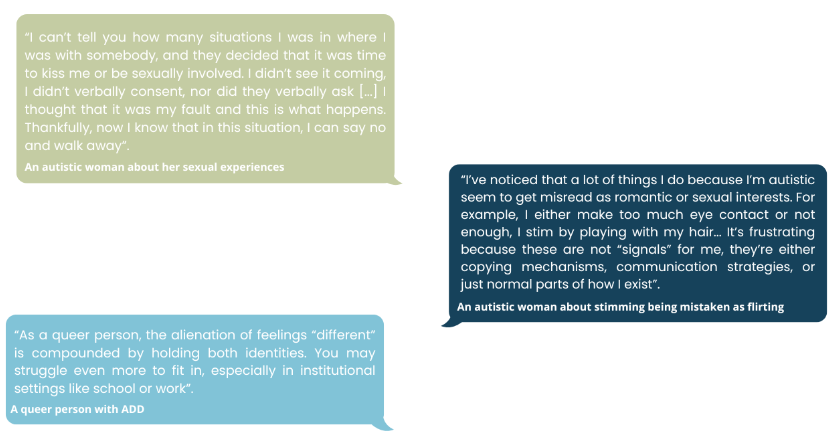
Potential Limitations of Current Prevention Strategies
Prevention strategies do not always reflect the realities and needs of neurodivergent youth. The following examples highlight potential gaps that prevention strategies might entail that can easily make them less inclusive of neurodivergent youth:
- presenting consent as a strictly binary choice (“yes” or “no”), rather than recognizing it as an ongoing process that can evolve throughout an interaction;
- providing little or no education about implicit social cues and unspoken expectations related to sexuality, making them more difficult to recognize and interpret;
- focusing exclusively on verbal expressions of consent, without considering that some neurodivergent people may become temporarily nonspeaking during periods of stress, sensory overload, or intimate situations;
- offering few opportunities to develop self-awareness, including recognizing one’s intuition, desires, needs, and personal boundaries;
- giving limited attention to neurophysiological survival responses, such as the freeze response or the fawn response (people pleasing or appeasing behaviours), even though these reactions may be more common among some neurodivergent individuals.
Strategies for More Inclusive Prevention
The following tools and strategies can help make prevention initiatives more inclusive and better adapted to the realities of neurodivergent youth in educational settings. This list is not completed, but an attempt that could spark inspiration:
- Teach different ways of expressing and recognizing consent, including both verbal and non-verbal communication.
- Make implicit social norms and expectations surrounding interpersonal interactions explicit to promote mutual understanding.
- Provide tools that foster self-reflection and help young people identify their personal needs and boundaries.
- Raise awareness of stimming to reduce misunderstandings during social interactions.
- Educate participants about physiological survival responses, such as the “freeze” response, so they can better recognize these reactions in themselves and others.
- Acknowledge the diversity of sensory profiles and the different ways people experience physical touch.
- Encourage regular relationship “check-ins” to support ongoing consent and ensure everyone’s comfort and well-being.
- Strengthen communication skills that help individuals express their expectations, needs, and personal boundaries clearly.
- Recognize that personal boundaries are nuanced and may change depending on the context, helping to foster safer environments.
- Value diverse communication styles and adapt interactions to meet each person’s needs.
Additional resources on neurodivergence and violence prevention are available from organizations such as the Sex Information and Education Council of Canada (SIECCAN), Autism and/or Intellectual Disability Knowledge Exchange Network (AIDE Canada), and the Montreal Autism and Asperger Clinic.
Reflecting on Current Practices
The following questions can serve as a starting point for assessing how inclusive current prevention programs are. Reminder, inclusion is a process more than a goal in itself:
- Do prevention programs address different ways of expressing and recognizing consent, including non-verbal forms of communication?
- Are implicit social norms and expectations explained in a clear and accessible way?
- Do prevention initiatives consider the needs of people who may become temporarily nonspeaking due to sensory or emotional overload?
- Are prevention strategies adapted to the realities and needs of neurodivergent people?
Rethinking Consent
Common notions of consent easily entail some “neurotypical assumptions” – assumptions that do not always work for neurodivergent youth. Adapting the way consent is understood and taught to reflect neurodivergent realities helps create safer and more inclusive environments for everyone. This includes:
- Recognizing diverse communication styles: considering both verbal and non-verbal expressions of consent to ensure everyone’s safety and pleasure.
- Respecting different information-processing speeds: allowing each person the time they need to understand, reflect, and express agreement or refusal, not everyone knows immediately what they want or don’t want.
- Promoting clear and explicit communication: avoiding reliance on implicit or ambiguous social cues when interpreting consent. Desire is often more complex than a simple yes/no, consent also entails conversations on what a “maybe” or an “I don’t know” means for each person, in each setting, and relationship.
Key Takeaways
Takeaway #1: Neurodivergence influences how people perceive, interpret, and experience social interactions. Prevention strategies must take these differences into account to be truly inclusive.
Takeaway #2: Effective prevention relies on communication that is clear, explicit, and accessible. It should not depend solely on implicit social norms or unspoken expectations.
Takeaway #3: Consent is an ongoing process that requires communication adapted to each person’s needs, pace, and way of communicating.
Takeaway #4: Inclusive prevention aims to empower young people to recognize their needs, identify their personal boundaries, and express free and informed consent.
References
- Barnett, JP., et al. (2015). Qualitative Exploration of Sexual Experiences Among Adults on the Autism Spectrum: Implications for Sex Education Available at: Qualitative Exploration of Sexual Experiences Among Adults on the Autism Spectrum: Implications for Sex Education
- Cazalis, F., et al. (2022). Evidence That Nine Autistic Women Out of Ten Have Been Victims of Sexual Violence. Frontiers in Behavioral Neuroscience. Available at: Evidence That Nine Autistic Women Out of Ten Have Been Victims of Sexual Violence
- Layle, P. (2024); But Everyone Feels This Way: How an Autism Diagnosis Saved My Life.
- Sirois, C. (2024). Les difficultés associées à différents profils d’enfants québécois maltraités établis sur la base des incapacités qu’ils présentent du point de vue du personnel intervenant en protection de la jeunesse. Faculté d’éducation, Université de Sherbrooke. Available at: Les difficultés associées à différents profils d’enfants québécois maltraités établis sur la base des incapacités qu’ils présentent du point de vue du personnel intervenant en protection de la jeunesse
- The Learning Network (2026). Neurodivergence and Gender-Based Violence: Supporting Neurodivergent Survivors in GBV Contexts. Available at: Learning Network: Mobilizing knowledge to end gender-based violence
- Price, D. (2022). Unmasking Autism: Discovering the New Faces of Neurodiversity. Harmony Books.
- Silberman, S. (2015). NeuroTribes: The Legacy of Autism and the Future of Neurodiversity. Avery.


